How Instructional Leaders Are Getting Full Visibility into Classroom Observations
School and district leaders from across the country share their journeys toward achieving full visibility into their classrooms.


When we ask most district leaders about observations across their district, they often tell us they don't actually know how things are going. What sounds like a simple question: what is actually happening in their classrooms? In practice, it is actually a very difficult question to answer.
We recently brought together six districts for our Instructional Leadership Virtual Showcase. School and district leaders from across the country shared their journeys in finding the answer to that question and highlighted the real obstacles their schools face. They didn’t just talk about the improvements they made, but shared their data, frameworks, and the systems built to get them there.
What they had in common was a drive to ensure that what happens in a classroom observation doesn't stop at the building level, but connects all the way up to district goals.
Changing School Culture
When the culture around classroom observations and feedback has to change before anything else can
Dorchester School District Two had already identified its problem. Their observation process was getting in the way of the ultimate intent - coaching. All the requirements made it feel more compliance-driven, and teachers knew it. The visit often happened because it was required, the form got filled out because it had to be, and the feedback provided didn’t feel helpful. All parts of that observation cycle weren’t set up to successfully support teachers and change instruction.
Assistant Superintendents, Dr. Kenneth Wilson and Dr. Katie Barker described what it took to shift out of it: narrowing the observation tool from ten focus areas down to two or three, building feedback that gave teachers something specific to try the next day, and using the data to find patterns across schools rather than evaluate individuals.
The reframe mattered as much as the mechanics. Once teachers understood that observations were about consistency, coaching, and not catching, and forming professional learning, the school’s culture changed across the district.
Hear it directly from Dorchester leaders below.
Dorchester School District Two Presentation
Launching Learning Walks
What it takes to get every level of your school district following the same learning walk process and using a common language
Lancaster County School District had a different starting point. The issue was not culture. It was coherence. Walkthroughs were happening across 24 schools with no shared picture of what good instruction looked like, which meant observers across every building were looking for different things.
Chief Academic Officer, Trish Sexton addressed that by working backwards: defining what strong instruction looked like in the core content areas, building that definition into the observation process, and making sure principals understood the framework before they were expected to observe for it. Their Core Action Walks were structured around student actions rather than just teacher behaviors. The data that came back fed directly into instructional leadership team conversations at the school and district level.
In their first year, Lancaster completed more than 2,000 learning walks. By year two, school-level teams were running the process themselves. The results that followed, a top-six ranking out of 75 South Carolina districts in multiple elementary math grades and double-digit gains in third-grade literacy and math, came out of that groundwork. That kind of focus and consistent effort is hard, but Trish and her team trusted the process, and the instructional growth and academic achievement followed.
Hear it directly from Lancaster leaders.
Lancaster County School District Presentation
Aligning Walkthroughs and Evaluations
The clarity of informal observations and evaluations using the same language
One of the more persistent structural problems in instructional systems is the gap between informal observation and formal evaluation. Teachers are often coached under one framework and evaluated under another. The language doesn't match, and the expectations often don't align to each other. And because the two systems never connect, sometimes teachers feel pulled in two directions at once. When that confusion gets layered on top of competing district priorities, feedback can start to feel contradictory from one visit to the next.
Litchfield Elementary School District in Arizona experienced that pain for years and decided to create one framework to align all of its work. Their Cascading Evaluation Framework starts with their portrait of a graduate, what they want students to know and be able to do by the end of eighth grade, and works backwards through every role in the district. The same domains that describe their ideal student describe their ideal educator and describe the framework for their strategic goals, which ensure alignment throughout every level of their organization.
Deputy Superintendent, Bridget Duzy and Assistant Superintendent, Jennifer Benjamin described what continued to shift as the work evolved. Because staff had been working with the framework language through walkthroughs all year, the formal evaluation felt less like an external judgment and more like a natural checkpoint in an ongoing conversation. For teachers, that consistency is the difference between an evaluation that arrives out of nowhere and one they can actually prepare for.
Hear it directly from Litchfield Elementary School District.
Litchfield Elementary School District Presentation
Making Walkthroughs Actionable
What is looks like when you intentionally invest in walkthrough observations
Over the course of the last 15 years, District Five of Lexington and Richland Counties, has built a system where walkthroughs don't stop at collection. Chief Academic Officer, Tina McCaskill, Principal, Courtney Sims, and Assistant Principal, Jaime Powell shared how they have developed a process where observations flow into progress monitoring meetings, informing which teachers get observed more frequently, and how they use observation data to inform professional development decisions.
The question they keep coming back to is not how much data they have, but how it is actually driving change at the classroom level. That focus is what separates a school district that maintains, from a system that intentionally moves the needle.
Hear it directly from the District Five team.
District Five of Lexington and Richland Counties Presentation
Monitoring Core Learning Actions
Running one focused instructional playbook across 81 schools
We’ve seen firsthand that the larger the district, the harder it can be to answer a simple question: are students getting the same quality of instruction regardless of which building they walk into? Portland Public Schools realized they weren’t able to answer that question.
Senior Chief of Academics, Kristina Howard and Director of Teaching & Learning, Kristen Moon shared how PPS identified three core learning actions, based on their instructional framework through many small group sessions. They took those core learning actions and put them at the center of every layer of the school district. Ultimately, every observer, from the a coach to the a central office leader, was looking for the same things in every classroom.
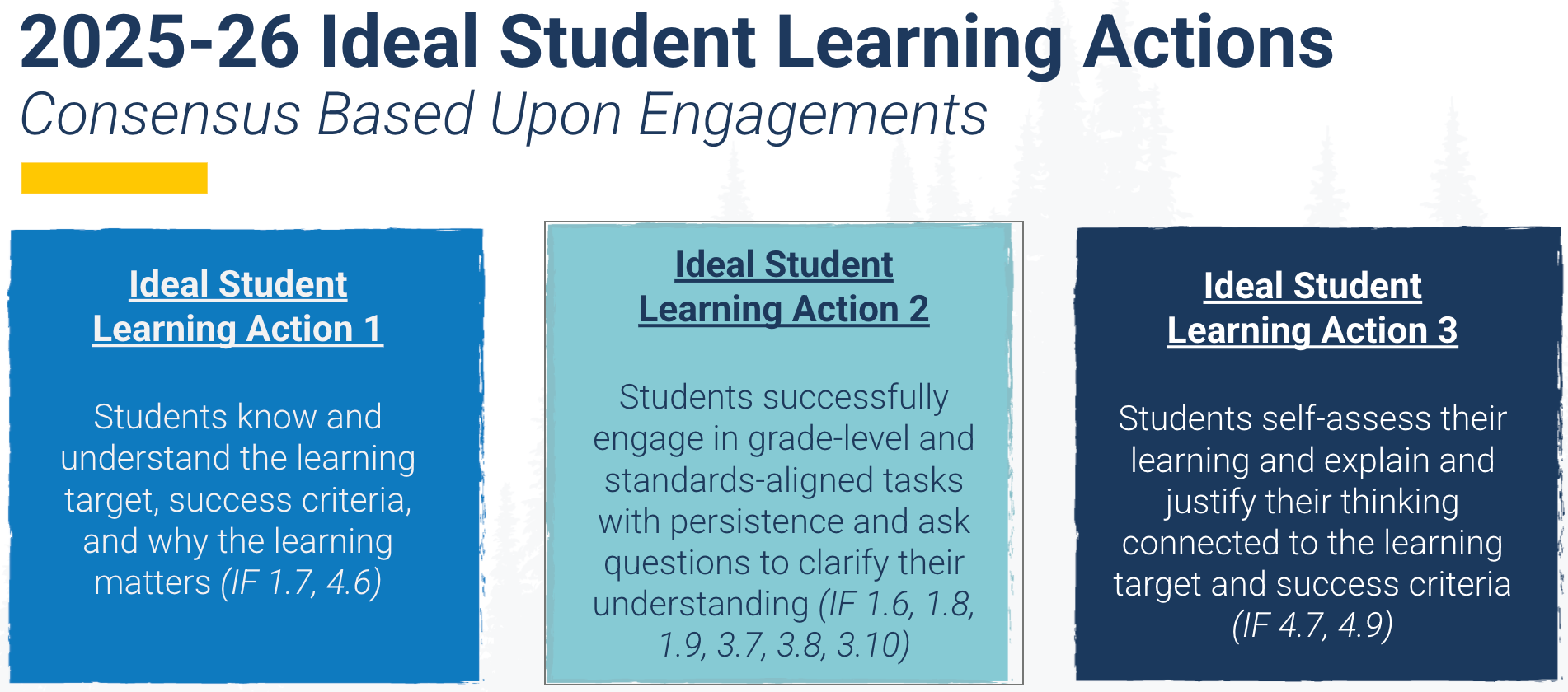
In their first year, with that focused approach, Portland saw a three percentage point gain in both ELA and math across all student demographic groups. Kristina and Kristen were excited that these are early signs of success, and that the focused work is ongoing.
Hear it directly from the Portland Public Schools leaders.
Portland Public School Presentation
Creating a Cohesive System of Supports
Building a cohesive picture of classroom instruction across 100 schools
Greenville County Schools, the largest district in South Carolina, was dealing with a visibility problem. With more than 77,000 students across 100 school sites, every building was running its own observation process. They were using different tools, different forms, with no practical way to create a shared picture of instruction. That kind of fragmentation makes district-level decisions about teaching and learning essentially impossible to ground in reality.
After standardizing on a single platform and shared instructional protocol, the district captured more than 10,000 observations in one year, visible at the classroom, school, and district levels simultaneously. For the first time, leadership could ask real questions of their observation data: where were observers spending their time, which grade levels needed the most support, where was student ownership of learning showing up consistently, and where was it missing? The data didn't answer those questions automatically, but it made asking them possible.
Greenville didn’t stop at walkthroughs. They layered in teacher evaluations, learning walks, instructional rounds, and coaching cycles to create a comprehensive support system for teachers
Hear it directly from the Greenville County School District leaders.
Greenville County School District Presentation
Full Showcase
Behind each of these stories is a system built to make this kind of work sustainable. All six sessions are free to watch on demand, and each one gets into the specifics.
If you're ready to see what this looks like in your district, sign up for a demo here.